

World Turtle News, 07/26/2015

Rustic conditions for some volunteers Showering with crabs and sleeping though the day, to excavating a sea turtle nest to a crowd of eager onlookers at the beach; all are different aspects of the volunteering life, so check the Volunteering section for a brief glimpse. An interesting article on the predator and prey relationship between sharks and sea turtles, see the Ecology section. And the […]

World Turtle News, 07/26/2015 Read More »
World Turtle News, 07/24/2015

Sea Turtles the focus of today’s news. Numerous stories on sea turtles populate the news wire today, including stories of rehab, marine debris, and an increase is nests being spotted in many locations. It seems this has been a great year for sea turtle nesting in many locations; today’s stories focus on Alabama and North Carolina. Meanwhile, some adult sea turtles aren’t so lucky, as

World Turtle News, 07/24/2015 Read More »

World Turtle News, 07/23/2015

Ridley is making progress Ridley the sea turtle, who is convalescing at Wellington Zoo, NZ, is managing a bit of paddle; check out the video. Local researchers use dogs to locate box turtles and nesting sea turtles (Carreta Carreta) return to Sicily, plus more in the Conservation Section. The Gray Fossil site produces another new turtle species (Sternotherus palaeodorus), see the Natural History section. Meet

World Turtle News, 07/23/2015 Read More »

World Turtle News, 07/22/2015

In case you needed another reason not to eat sea turtles… Studying turtles off the northwestern coast of Mexico, researchers have found these turtles harbor varieties of antibiotic resistant bacteria. They found three species belonging to the genus Vibrio, which is best known for the bacteria that causes cholera. Another species has been known to cause gastroenteritis, wound infection, ear infection, and even septicemia. After

World Turtle News, 07/22/2015 Read More »

World Turtle News, 07/21/2015

Sea Turtle Prep Well if you want to know what it takes to go on sea turtle patrol then read the top story in the Conservation section. Also the Kemp’s Ridley (Lepidochelys kempii) rescued in Wellington, NZ has begun eating. Twenty-eight western pond turtles (Actinemys marmorata) are returned to their home in Mountain Lake. Look out for your toes in Weber River as Snapping Turtles

World Turtle News, 07/21/2015 Read More »

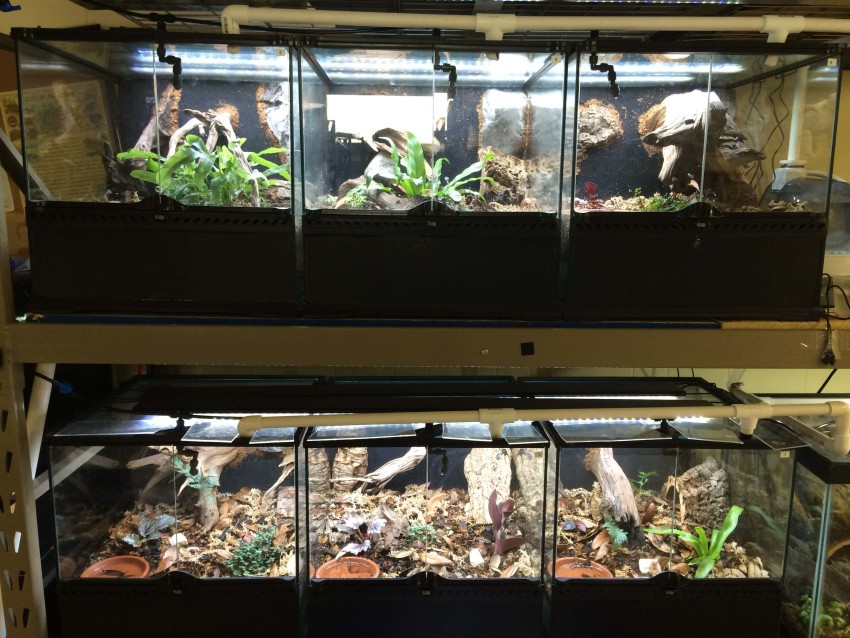
Custom vivariums designed by Joe of theTurtleRoom for Geoemyda spengleri (Vietnamese Black-Breasted Leaf Turtle)

Custom Vivarium Build, Part 4

The Fog Rolls In

Joe shares the final installment in his custom vivarium build series. Watch as Joe, Husbandry Specialist, explains how he designed and built his new custom Geoemyda spengleri (Vietnamese Black-Breasted Leaf Turtle) vivariums. This is the final part of the series. Part 1: Making a False Bottom Part 2: Creating a Live Background Part 3: Indoor Thunderstorm

Custom Vivarium Build, Part 4 Read More »

World Turtle News, 07/19/2015

Coyote flag deterrents On Sullivan’s Island the coyotes have started predating sea turtle nest, something they have never done before. The local volunteers are trying a novel deterrent. More sea turtles with injuries suggest there are more sea turtles out there and conservationists in Magong discuss sea turtle conservation: see the Conservation section. A Leatherback sea tutle (Dermochelys coriacea) is spotted off Tireem, Scotland: see

World Turtle News, 07/19/2015 Read More »

World Turtle News, 07/17/2015

Hatchling of Palawan Forest Turtle Gives More Evidence Of Poaching The Palawan Forest Turtle (Siebenrockiella leytensis) is a critically endangered species endemic to the Palawan island in the philippines. Its major threats, as many other speckes, are poaching for the international pet trade, for food and for traditional medicine. While this species is fully protected under domestic legislation, the international trade of captive-bred animals is

World Turtle News, 07/17/2015 Read More »

World Turtle News, 07/16/2015

Two William & Mary students research terrapin nest predation/destruction. While crows and raccoons may be the two most common predators of Diamondback Terrapin nests in Maryland’s Eastern Shore region, these two students are studying an unlikely “predator”, the invasive plant species Phragmites australis (common reed). Because of their height creating more shade, these plants could change nest temperatures. Perhaps even more important, is how their

World Turtle News, 07/16/2015 Read More »

Shopping Cart
Scroll to Top